
Birgit’s parents
Olga and Bengt
Olga Bruno 1895–1973 · Bengt Danielsson 1900–1981
She was a child from Gothenburg who grew up in a children’s home and as a foster daughter on a farm in Södermanland – and became a teacher. He was the crofter’s son from Lien who became a machinist at the Krångede power station. Together they had five children in Ragunda, among them Birgit. And Olga wrote down her own childhood, in a little exercise book from Sollefteå.
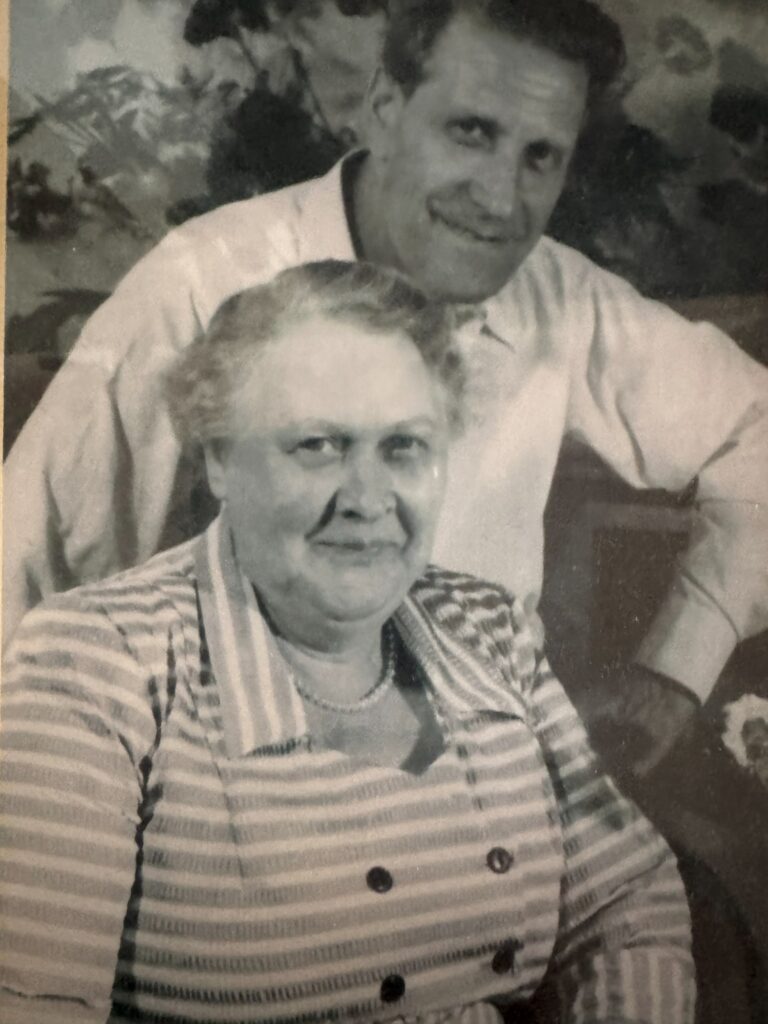
Olga and Bengt Danielsson.
Grandmother Olga
From Gothenburg to Bettna
Church records and censuses let us follow Olga Victoria Ottolina Bruno through a childhood she did not choose – from poverty in Gothenburg, via a children’s home in Djursholm, to a farm in Sörmland.
1867
Olga’s mother, Alida Olivia Bruno, is born in Gothenburg. At thirteen, in 1880, she lives in the city’s poorhouse and is recorded as “sickly”.
1895
Olga is born on 29 July in Gothenburg Cathedral parish, out of wedlock. Her father is unknown.
1900
Five-year-old Olga lives alone with her mother in Lunden, Örgryte, on the edge of Gothenburg.
1901
On 13 November Olga, six years old, is moved to the Svithiod children’s home in Djursholm outside Stockholm – a home for some ten girls under the matron Sofia Charlotta Åsander. The parish register reads: “Baptised. Mother: unmarried Alida Olivia Bruno.”
1902
On 23 February Olga’s mother Alida dies of scarlet fever in Lunden, Örgryte, only 34 years old – five months after Olga was sent to the children’s home. Six-year-old Olga is now an orphan.
1902
On 3 July Olga leaves the children’s home and comes as a foster daughter to the tenant farmer August Alfred Lind and his wife Emma Josefina at Pipartorp in Bettna parish, Södermanland. The family has a daughter, Anna Wilhelmina – and three years earlier lost five-year-old Alfrida, “Frida”.
1910
On 15 May Olga is confirmed in Bettna church – with “foster father August Alfred Lind” entered in the confirmation book. The family now lives at Rallersta, and the household also includes the maid Elsa.
1919
On 7 December Olga moves from Bettna to Hotagen in Jämtland and becomes an infant-school teacher in the village of Bakvattnet – the dream from the exercise book has come true. Where she trained is not yet known.
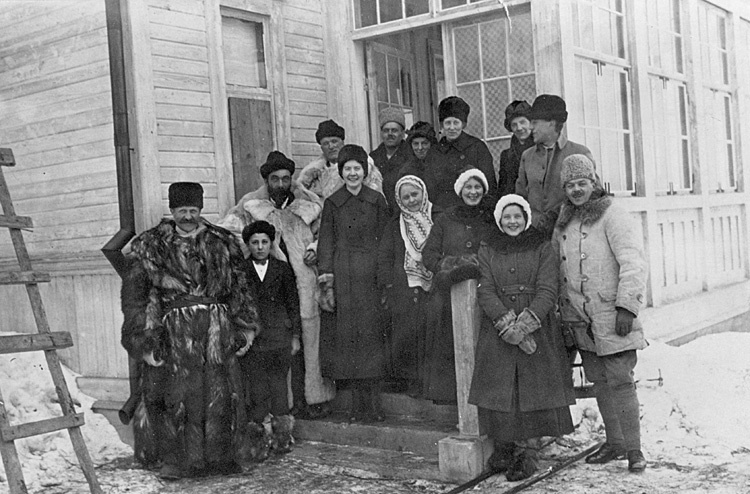
Outside the coaching inn at Tulleråsen, Offerdal, 1919. Olga Bruno, “teacher in Bakvattnet”, is the first woman from the left. Photo: Jamtli, JLM 85X179 3 (CC BY 4.0).
The 1920s
In September 1920 Olga moves to Kungsholmen in Stockholm. In 1922 she marries Bengt Danielsson in Ragunda, Jämtland.
She had to leave her mother at six and never saw her again. Her own account of the road from there survives – in her own handwriting.
The exercise book
“Love seeketh not her own”
Among the family papers was a plain exercise book from Dahlberg’s bookshop in Sollefteå. On twelve pages, in neat pencil, it tells of the foster daughter Eva and the farmer’s son Arne, who attend confirmation classes at the vicarage one spring. No name, no date – but everything suggests that Olga wrote it, and that she was writing about herself.
The names are changed – Lind has become “Olsson” and Olga has become Eva – but set beside the church records from Bettna, most of it fits:
Eva in the story – Olga in the records
- An orphaned foster daughter who came to the farm as a small child – Olga came to the Linds at Pipartorp in 1902, aged six, in the months after her mother’s death.
- The foster father is a prosperous farmer – August Alfred Lind was a tenant farmer with farmhands and a maid.
- The little grave with the name “Frida” – the Linds’ daughter Alfrida Josefina died in 1899, five years old.
- “More than our own girls are” – the Linds had two living daughters of their own.
- Elsa, “a dear girl who served on the farm” – the maid at Rallersta in 1910 was called Elsa.
- Confirmed in spring, aged fifteen – Olga was confirmed in Bettna on 15 May 1910, two months before her fifteenth birthday.
- The dream of becoming a teacher – and Olga did: an infant-school teacher in Hotagen in 1919.
Even what looks like a difference turns out to be true. Olga’s mother Alida died of scarlet fever on 23 February 1902 – so when Olga came to the Linds that summer, she had no living parent. And the little grave with the name Frida was real: the Linds’ daughter Alfrida Josefina died in 1899, five years old.
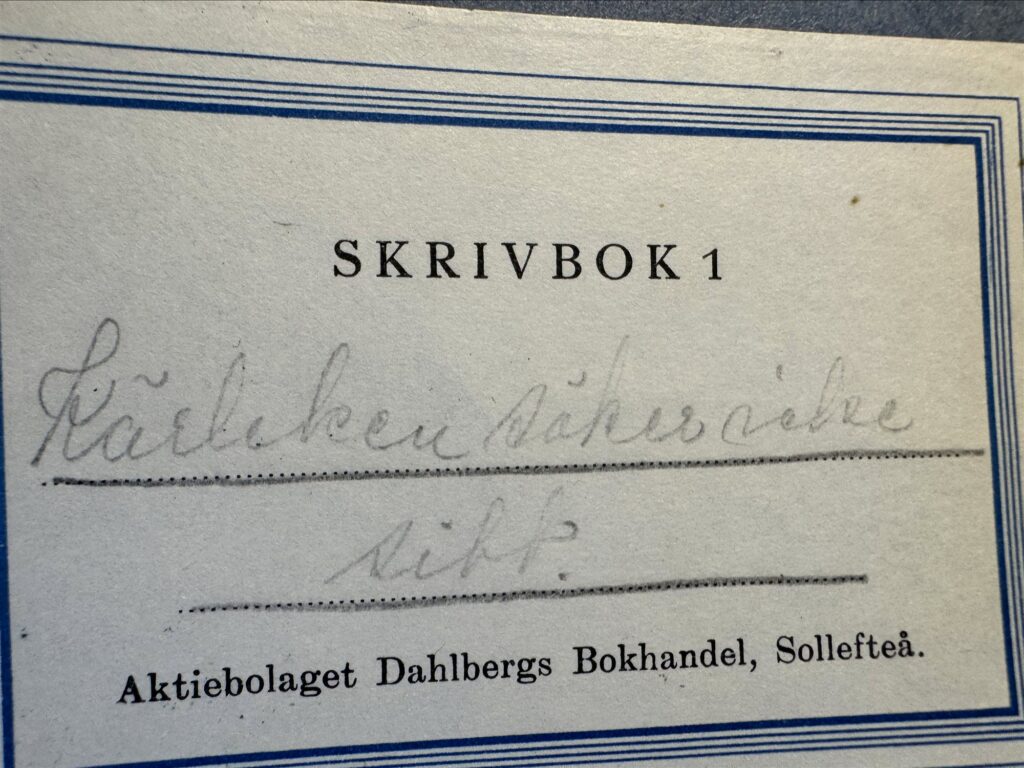
The cover – an exercise book from Dahlberg’s bookshop in Sollefteå.
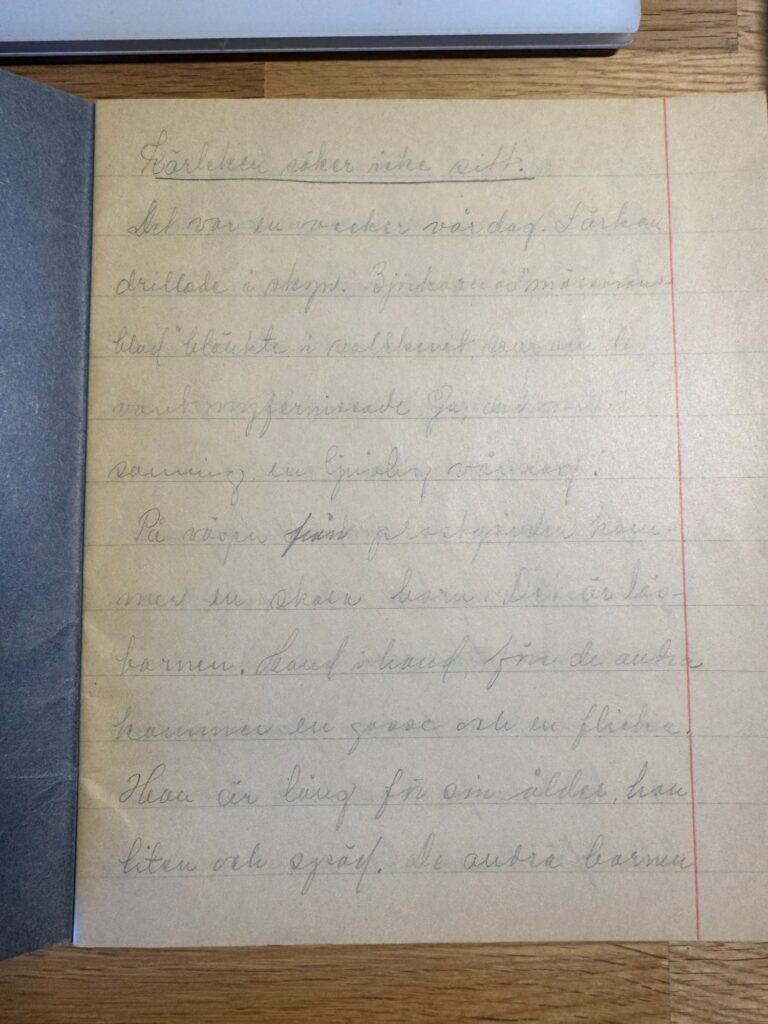
The first page: “Love seeketh not her own.”
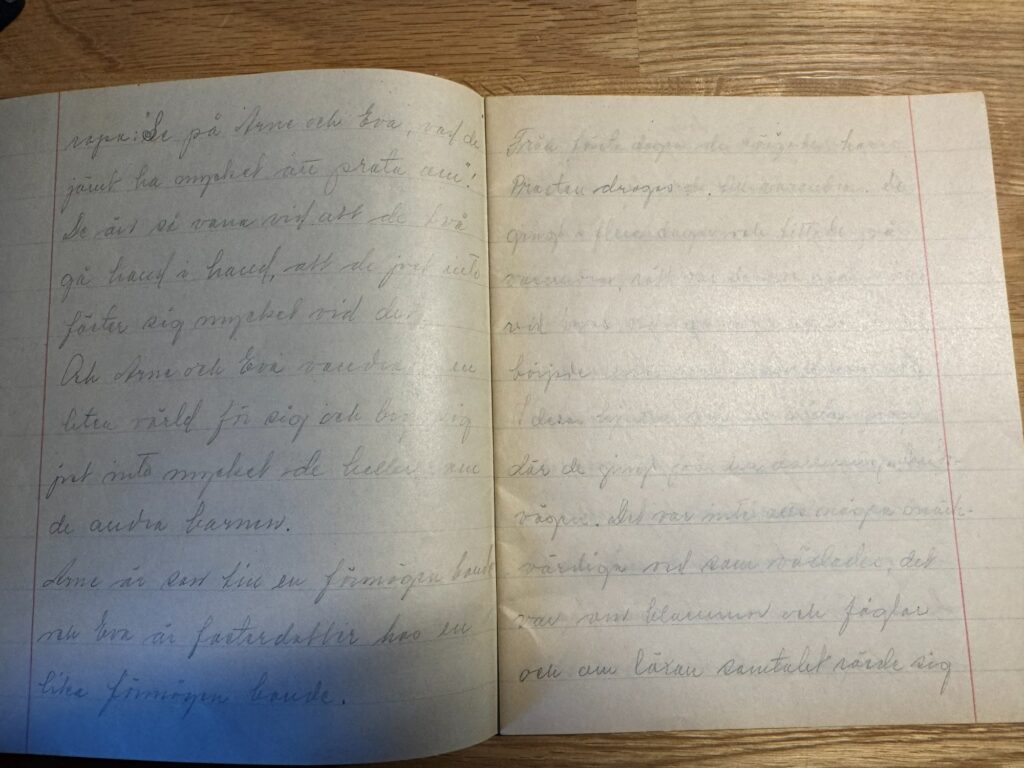
Arne and Eva on the road from the vicarage.
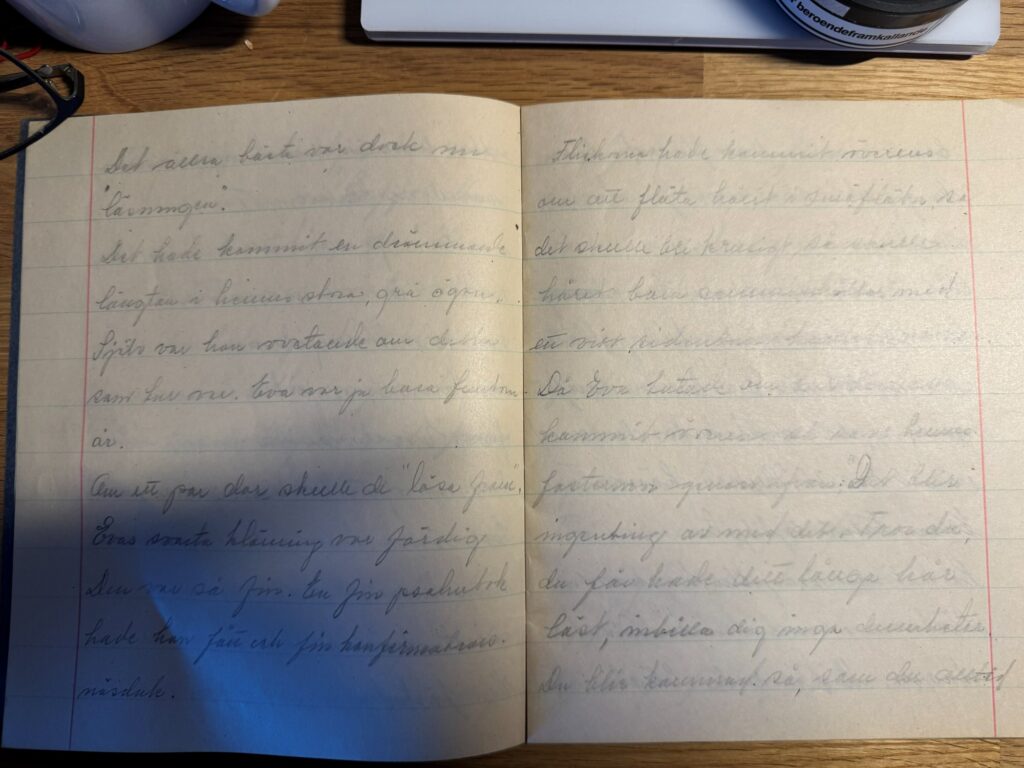
Confirmation classes and the plaited hair.
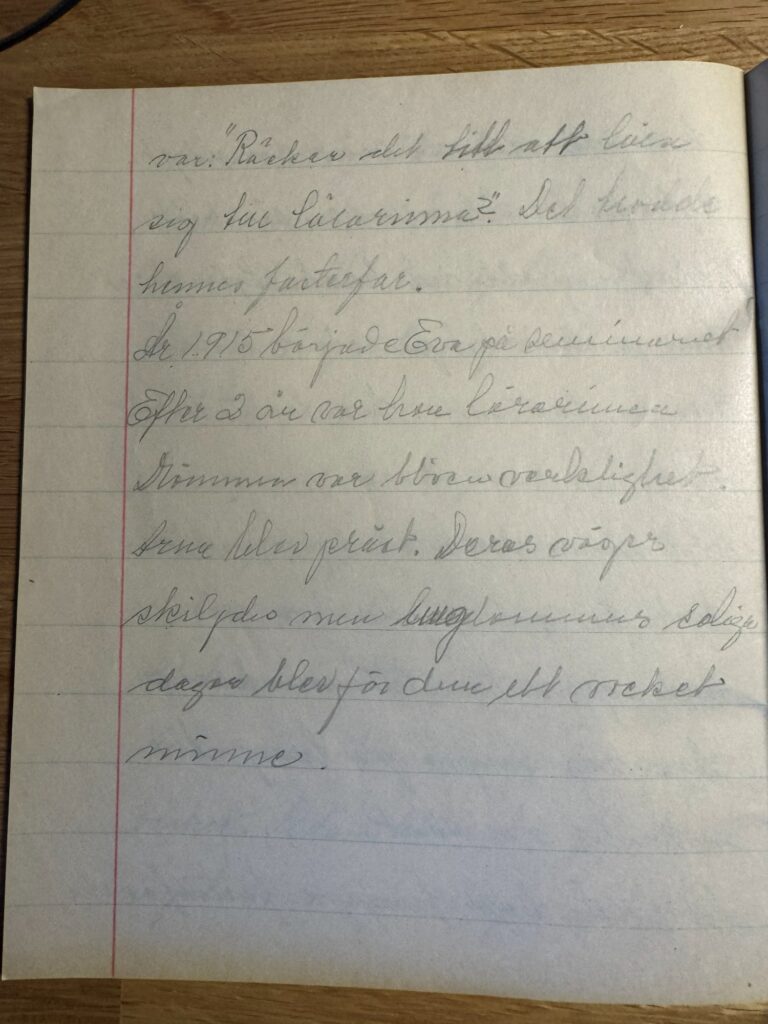
The last page: “In 1915 Eva started at the seminary.”
Olga’s story
Love seeketh not her own
The whole exercise book, translated from the Swedish. In a few places the pencil is so faint that words cannot be read – these are marked with …
It was a beautiful spring day. The lark was trilling in the sky. The birches’ “mouse-ear leaves” shone in the sunshine as if they had just been varnished. Yes, it was truly a lovely spring day.
Along the road from the vicarage comes a crowd of children. They are the confirmation pupils. Hand in hand, ahead of the others, come a boy and a girl. He is tall for his age, she small and slight. The other children … call out: “Look at Arne and Eva, how they always have so much to talk about!” They are so used to the two walking hand in hand that they hardly take any notice of it.
And Arne and Eva wander in a little world of their own and hardly care much about the other children either. Arne is the son of a prosperous farmer, while Eva is the foster daughter of an equally prosperous farmer.
From the very first day they began going to the vicar they were drawn to each other. … They walked along the dusty country road. It was not petty worldly words they exchanged; it was about flowers and birds and the lesson that their talk turned … mostly they walked in silence. Soon they reached the fork in the road, and there their ways parted. It was always hard to leave each other. But in a couple of days they would meet again.
Eva and her friends had twenty kilometres to walk to the vicarage. But nobody grumbled about the road; it was simply such fun every day to go and “read”, as it was called. Soon they would be confirmed, and the girls had a great deal to talk about – how they would be dressed and how they would have their hair plaited …
Eva had come to her foster parents as a little girl of five. Her parents were dead, and she had no one in the world who was close to her. It was a good home Eva had found.
The foster mother was a capable woman, but strict and stern. She often looked with stern eyes at Eva, whose cheerful, lively temper she did not understand. But Eva took scoldings and admonitions with the same good cheer. “Yes,” the foster mother often sighed, “it’s like water off a goose! She is just as cheerful anyway.”
Her cheerful temper was, after all, the only wealth little Eva owned in this world. … to take little Eva on one’s knee or to stroke her cheeks – nobody thought of that, and so she went about with her longing. Then she turned to the animals. The cows, the horses, the sheep with their lambs – yes, nearly all the animals on the big farm became her friends in time. And she could sing. She sang all the time. So you could always hear where Eva was.
She had been allowed to take part in all the chores. She was not very strong, but her good will and cheerful temper always helped her. The thing she liked best was milking the cows. It was so warm and quiet in the big cowshed, where the cows stood in long rows, well-groomed and glossy. Eva talked to them … Elsa was a dear girl who served on the farm. Eva and Elsa were good friends. They shared all the work gladly.
The day began at half past four. The girls had a custom that one of them got up first and made coffee for the other. But there was no lying in bed. The milking had to be done by half past six. Then the milk was to be driven to the dairy, ten kilometres from the farm.
Still, Eva enjoyed all the work – out in the cornfields, the turnip patch, the potato field, the kitchen chores and all the indoor work; yes, everything was fun. But her dearest occupation was reading. If she got hold of a book, why, then she forgot everything … “Eva ought to be allowed to go on studying, she has such a good head for books.” Eva wished to become a teacher, but how that could come about she did not know. She understood, of course, that it was unthinkable.
But the very best thing now was the confirmation classes. A dreamy longing had come into her big grey eyes. She herself, luckily, was unaware of it. Eva was, after all, only fifteen.
In a couple of days they were to be confirmed. Eva’s black dress was ready. It was so fine. She had been given a fine hymn book and a fine confirmation handkerchief.
The girls had agreed to plait their hair in little braids so that it would be curly. Then the hair would only be held together with a certain silk ribbon … When Eva told her that they had agreed on this, her foster mother refused at once: “Nothing will come of that. Do you think you’ll be allowed to wear your long hair loose? Don’t imagine any such nonsense. You’ll be combed the way you have always been combed and plaited – you’d shame yourself before the whole parish.”
And so it was. Eva’s long hair was plaited into one long braid that reached well below her waist, where it ended in a white bow. Neither pleas nor tears helped.
Then off they went to the church. The confirmands gathered in the … cottage. With a single glance Eva saw that all the girls had their hair done the way they had agreed. She was the only one who stood out from the crowd … she was, after all, the only one who was a foster child … away into a corner, and her eyes filled with tears.
Two by two the girls walk into the church. She just has time to get an encouraging smile from Arne as they pass the boys, who were to follow the girls. Then they come into the beautifully flower-decked church.
Then Eva forgets all her sorrows. She is one of the dean’s favourite pupils. She has to answer many questions and recite long passages by heart. Small and slender she stood in her long black dress, but her face shone. Many people fixed their eyes on Eva and thought she did well. Everyone knew she was the foster daughter at the Olssons’.
“You did well in church, Eva,” said her foster father when they had come home. … He was always so good and kind. He always wanted to take her part. When the foster mother complained about Eva, he said: “I think Eva is fine, I do. Cheerful and willing all the time – that’s more than our own girls are.”
The next day the young people took their first communion. What Eva experienced at the altar rail she could never describe to anyone. It became something she always kept as her most precious treasure. Then the young flock walks out of the church. The sunshine beams towards them. Soon these young people must part. Life calls them to different tasks; soon they will have to stand on their “own feet”, as the saying goes.
Eva and Arne say goodbye to each other. Arne squeezes Eva’s hand and whispers: “Come to church next Sunday!” Eva promises. Arne … is to go to town and attend school. Eva was happy for him. She thought of her own longing to learn something.
The days of the week went quickly. When Sunday came Eva went to church; often they drove there, for Eva’s foster father was a devout churchgoer. Arne was always in church. When the service was over they would walk for a while and look at the graves. They always stopped at one little grave. On the headstone was the name “Frida”. Under the little mound rested a little daughter of her foster parents; Eva’s foster parents had taken Eva in place of the little girl they had lost. Eva often wondered how things would have turned out for her if little Frida had not died … “One man’s death is another man’s bread.” Eva felt great gratitude to God for the good home she had been given. She always wanted to bring flowers to the little grave – it was something she hid in her heart.
The summer passed quickly. It was the happiest summer Eva could ever remember. Then came autumn, and with it Arne’s journey to town and the grammar school. After that they did not meet until Christmas. Now and then Arne had sent Eva a postcard. It was always an especially happy day when that happened. She herself never wrote. It was not proper, said her foster mother. Eva thought all the more.
Then something remarkable happened. A good friend of Eva’s mother had given Eva two thousand kronor. For a long time Eva did not dare believe it was true. The first thing she asked her foster father was: “Is it enough to train as a teacher?” Her foster father promised it was. In 1915 Eva started at the teachers’ seminary. After two years she was a teacher. The dream had come true. Arne became a clergyman. Their ways parted, but the sunny days of childhood remained a beautiful memory for them both.
Grandfather Bengt
The crofter’s son from Lien
Bengt Ludvig Zackarias Danielsson was born on 25 February 1900 at Lien in Ragunda parish, Jämtland. His father, Axel Ludvig Zakarias Danielsson, was a farm labourer and later a crofter; his mother was Ida Katarina Margreta Backlund. Bengt was the third of six children: David, Per Axel, Bengt, Bror Oskar, Dagmar and Nils Ivan.
He went from the croft into the electric age. In 1930 he was an electrician living at Torsgård in Ragunda, and in 1941 he was a machinist at the Krångede power station – one of the largest in Sweden, built on the Indalsälven river in the 1930s. In the 1930 census his surname was spelled Davisson, but in the family he was Danielsson.
The family in Ragunda
The teacher and the machinist
Olga and Bengt married in 1922. They had five children – Ingrid (1923), Birgit (1925), Bo (1926), Ulla (1930) and Lars (1941) – and all the children took their mother’s surname, Bruno. In the family she was called Olga Danielsson; the gravestone reads Bruno-Danielsson.
Olga died at Krångede on 7 February 1973, and Bengt on 1 September 1981. They rest in the same grave in Ragunda churchyard, where their son Bo is also buried.
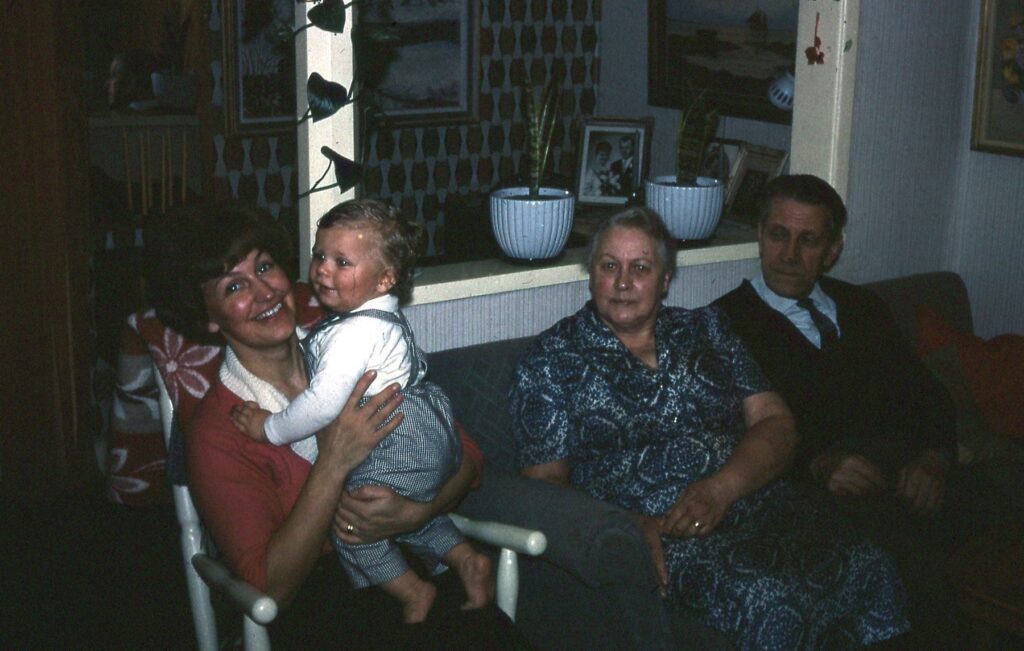
Birgit with little Erling on her lap, beside his grandparents Olga and Bengt.
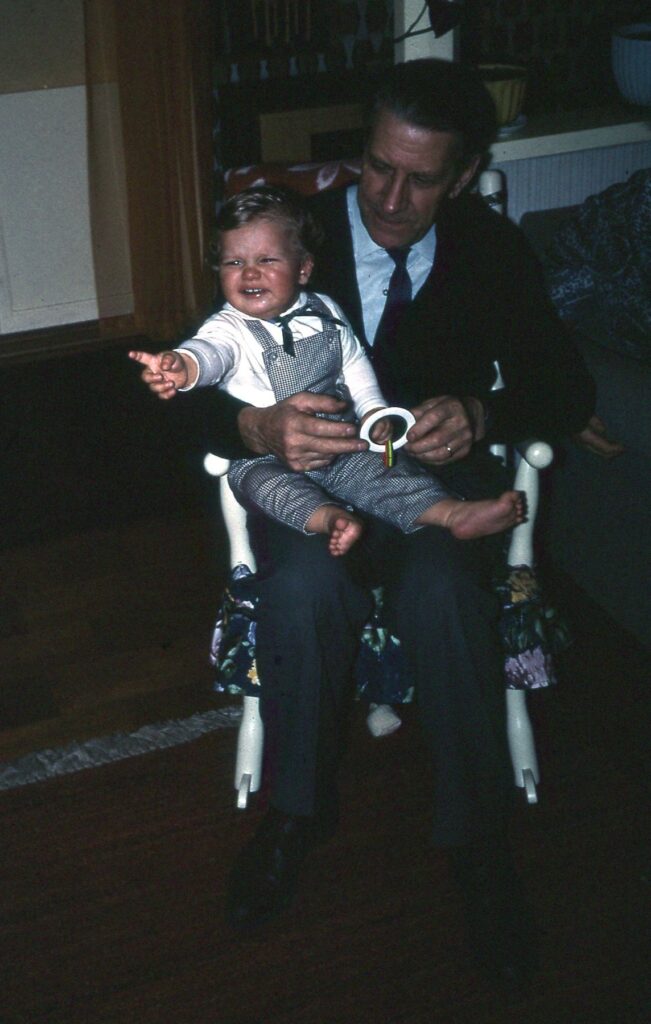
Grandfather Bengt with his grandson Erling.
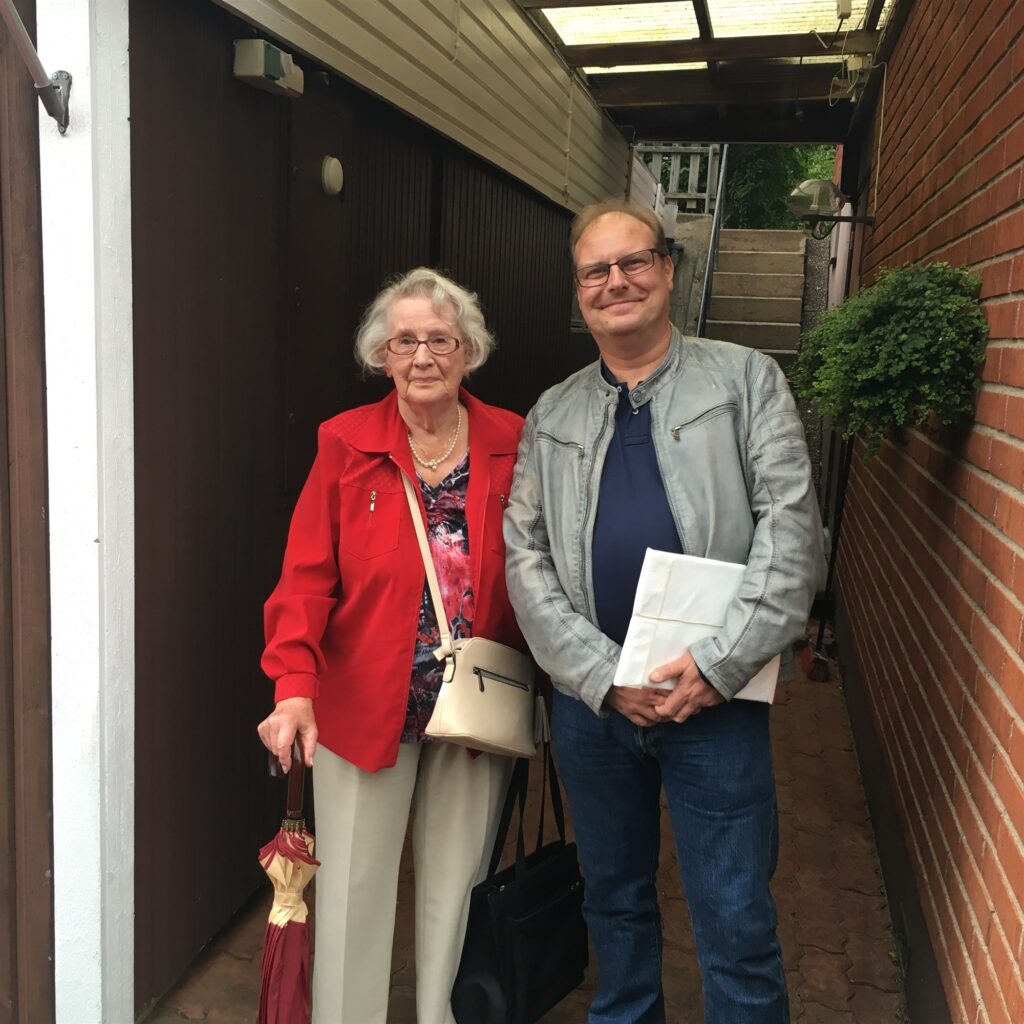
Aunt Ingrid, Olga and Bengt’s eldest daughter, with Erling Jr.
Sources: Swedish National Archives (Riksarkivet), censuses of 1880, 1890, 1900, 1910 and 1930; Örgryte parish archives (parish register 1898–1906, burial register 1902); Danderyd parish archives (removal register 1901, parish register 1901–1911); Bettna parish archives (household examination roll 1896–1899, register of arrivals 1902, parish registers 1905–1919, confirmation book 1910); Hotagen parish archives (register of arrivals 1919, parish register 1914–1932); Ragunda birth register 1941; SvenskaGravar.se. The exercise book: Grönstedt family archive.